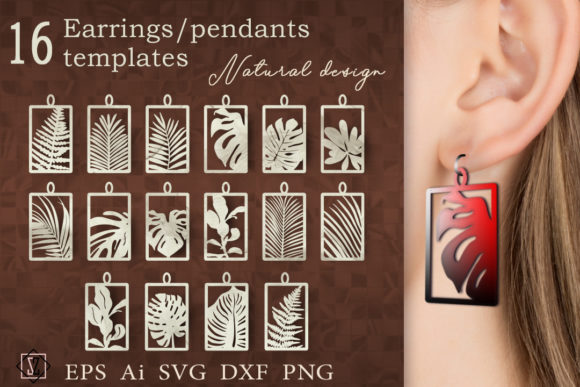
Earrings Pendants Templates.SVG
A Natural Motif That Whispers—Not Shouts
Opening Earrings pendants Templates.SVG feels like flipping through a quiet botanical sketchbook: delicate leaves, soft fern fronds, subtle seed pods, and asymmetrical floral silhouettes. There’s no aggressive symmetry or over-engineered geometry—just organic flow, gentle curves, and breathing room between elements. As an embroidery designer who’s stitched hundreds of nature-themed pieces for boutique clients and Etsy shops, I immediately sensed this collection’s strength: it leans into subtlety, not spectacle. That makes it ideal for projects where elegance lives in restraint—think embroidered linen tea towels for a wedding gift, minimalist baby onesies, or monogrammed aprons for a small-batch kitchen brand.
Where It Shines: Real Projects, Real Reactions
Last week, I tested one of the leaf-shaped templates from Earrings pendants Templates.SVG on a custom order: a lightweight cotton tote for a local herbalist. She wanted something botanical but refined—not literal, not fussy. I resized the SVG to 2.8" wide, digitized it as a clean satin-stitched outline with light fill stitch interior, and stitched it near the bottom corner of the bag. Customers noticed it instantly—not because it was loud, but because it felt *intentional*. One client even asked if it was hand-drawn. That’s the quiet power of well-proportioned natural forms: they read as thoughtful, handmade, and quietly confident.
It performed just as well on other surfaces: a soft-loop terry cloth kitchen towel (with medium cutaway stabilizer), a structured twill cap (hooped flat, using tear-away + topping), and even a stretchy bamboo-cotton blend onesie (light fusible + basting stitches first). In each case, the design retained its shape without distortion—no pinching at curves, no bleeding at tapered tips. That tells me the vectors were drawn with embroidery in mind: generous line weight, open negative space, and no micro-details that would vanish under thread.
Where to Pause—and Plan Ahead
That said, Earrings pendants Templates.SVG isn’t universally forgiving. On ultra-thin fabrics like silk charmeuse or chiffon, the outer satin stitch can ripple without careful tension control and ultra-fine needle choice (70/10 or smaller). On dark fabrics, especially navy or charcoal, avoid light pastel thread unless you’re adding a white underlay—otherwise, the delicate contours lose definition. And while the shapes are graceful, they’re not optimized for tiny hoops: anything under 3" diameter risks compressing the most slender stems or petal tips into unreadable blobs.
I also wouldn’t use these directly on highly textured surfaces like bouclé knit or thick corduroy without testing stitch density first. Dense fill areas can flatten texture too aggressively, making the design feel “stuck on” rather than integrated. And if you’re planning layered embroidery—say, stitching this pendant over a watercolor-printed fabric—check how much coverage the final stitch layout provides. Some versions in the set have open interiors; others are fully filled. Know which version you’re working with before committing to a production run.
What It Adds to Your Finished Product—Beyond Aesthetics
This is where Earrings pendants Templates.SVG earns its place in a serious craft business toolkit. It doesn’t just look nice—it elevates perception. A simple cotton pillow cover becomes boutique-worthy with one centered pendant. A plain sweatshirt gains quiet sophistication. A personalized baby blanket feels heirloom-level when paired with a single, softly stitched fern motif. Customers don’t just see a design—they register care, curation, and intentionality.
For Etsy sellers and small shop owners, that translates directly to trust and pricing power. You’re not selling “an embroidery file”—you’re offering a cohesive visual language. These templates work beautifully in printable mockups too, lending authenticity to digital listings. And because they’re rooted in natural forms, they scale gracefully across product types: same pendant shape works as a patch, a tote bag accent, a nursery wall hanging, or a holiday ornament appliqué.
Practical Designer Notes—Before You Stitch
- Always test on scrap fabric first—especially if using textured, stretchy, or dark materials.
- Check thread color contrast in both natural and artificial light. What reads clearly on screen may fade on fabric.
- Review stitch density before scaling up or down. Overly dense fills on small versions cause puckering; overly sparse ones on large versions look unfinished.
- Confirm hoop size compatibility. If your smallest hoop is 4", avoid resizing any template below 3.2" wide.
- Inspect corners and taper points at actual stitch-out size—some vector points translate poorly into satin stitch transitions.
- Test black-and-white mockups to assess silhouette strength. If it disappears in grayscale, it’ll struggle on low-contrast fabric.
- Use proper stabilizer: medium cutaway for knits, lightweight tear-away for stable wovens, and always a topping (like Sulky Solvy) for napped or fuzzy surfaces.
- Verify licensing before selling finished items or bundling the SVG into digital product kits. Since this is categorized under Graphics and Crafts, commercial use may require clarification from the seller.
Final Thought: A Design That Serves the Maker
Earrings pendants Templates.SVG isn’t flashy—but it’s reliable, versatile, and deeply attuned to what handmade customers value: authenticity, calm beauty, and quiet craftsmanship. It won’t dominate a garment, but it will anchor it. It won’t shout “look at me,” but it will make people pause, lean in, and say, “I love the detail here.” For embroidery designers building a recognizable style, for Etsy sellers curating cohesive collections, and for craft businesses investing in timeless design assets—this is the kind of SVG that earns repeat use, not one-time novelty. Just remember: let the natural rhythm of the shapes guide your choices—not the other way around.