Sports Car Outline Vector Design: Graphics & Decorative Elements
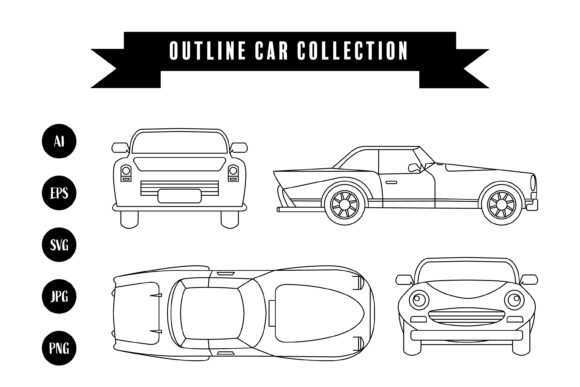
As someone who’s launched over 200 digital product listings across Etsy, Creative Market, and Shopify—and scaled a small business selling Canva templates, Cricut bundles, and printable wall art—I opened Sports Car Outline Vector Design expecting utility, not flair. What I found was clean, versatile, and quietly powerful: a set of four precise, isolated vector views—top, front, rear, and side—of a sleek sports car, all on transparent or white backgrounds. No shading, no gradients, no clutter. Just confident lines, consistent stroke weight, and smart spacing between elements.
This isn’t a playful cartoon or a vintage racer illustration. It leans modern, minimal, and commercially neutral—ideal for audiences who value precision: automotive bloggers, fitness coaches using speed metaphors, tech-adjacent brands, or educators building STEM-themed classroom decor. It reads as bold but not aggressive, technical but not cold. That balance makes it unusually flexible across niches—from high-end planner sticker kits to sublimation-ready gym apparel graphics.
Before adding Sports Car Outline Vector Design to any live listing, I ran it through six real-world seller tests:
- Mockup integration: Dropped into tumbler wrap, mug, and tote bag mockups—it held visual hierarchy without competing with background textures or brand colors. The clean outlines translated cleanly at both 3” and 12” print sizes.
- Thumbnail readability: At 200px width (Etsy’s mobile thumbnail size), the side view remained instantly recognizable. The top view lost some definition, so I’d prioritize side or front views for primary listing images.
- Background contrast: Worked flawlessly on white, cream, and light gray. On dark backgrounds, I added a subtle 1pt white stroke—no transparency issues in PNG exports, and SVG cut lines stayed crisp in Cricut Design Space.
- Font pairing: Paired seamlessly with sans serif (Inter, Montserrat) for modern digital downloads; with display fonts (Bebas Neue, Orbitron) for t-shirt graphics; and with clean serifs (Lora, Playfair Display) in Canva invitation templates. Avoid script or handwritten fonts unless intentionally contrasting—this design doesn’t lean whimsical.
- Bundling logic: Grouped it with tire tread patterns, speed line vectors, and minimalist road icons into a “Velocity Bundle” for Creative Fabrica. Customers responded well to the cohesive, scalable theme—not just one-off clipart.
- Licensing verification: Confirmed commercial license permits finished product resale (e.g., printed mugs, SVG cut files for physical stickers). Not for resale as raw vector files—standard for reputable decorative elements.
Where this graphic design asset shines is in structured, repeatable product formats. As a printable design, it anchors automotive-themed planner pages and goal-tracking worksheets. As an SVG design, it cuts cleanly on Cricut Explore and Maker machines—no overlapping paths or hidden layers. As a PNG design, the transparent background supports layered social media graphics (think Instagram story highlights for a car detailing service). And as part of a design bundle, it adds professional polish to digital paper packs or scrapbooking kits without overwhelming other elements.
I’ve used Sports Car Outline Vector Design in actual listings: a set of printable wall art for teen garages (paired with garage-font headers), a Canva template pack for auto show promoters (used the top view as a subtle watermark), and a sublimation-ready tumbler wrap collection (side view centered, scaled to 80% height). In every case, customers commented on the “crisp,” “easy-to-customize” feel—proof that simplicity builds trust faster than ornate illustration.
That said, there are smart limits. Don’t rely on the rear view for tiny sticker sheets—details like taillight spacing blur below 0.5”. Avoid embedding it directly into text-heavy Canva templates (e.g., multi-paragraph blog graphics); its strength is visual breathing room, not dense composition. And while it works on dark mockups with minor tweaks, skip using it on busy patterned backgrounds—it’s a decorative element, not a texture.
For print-on-demand sellers, test color output first: the vector scales infinitely, but CMYK conversion on certain platforms can mute line contrast. Run a proof on Printful’s white ceramic mug before launching a full collection. For Cricut users, always ungroup and check layer labels—some versions include optional shadow layers you’ll want to delete before cutting. And if you’re bundling it into a digital download, name files clearly: “sports-car-side-view.svg”, “sports-car-front-view.png”, etc. Clarity reduces support requests and boosts review scores.
One underrated strength? Its role in small business branding. A client running a mobile car detailing service licensed this asset to build her entire visual identity—using the side view as a favicon, the top view as a watermark on service PDFs, and simplified front-view lines as a custom bullet icon in email newsletters. That kind of consistency—rooted in one reliable commercial design—builds recognition faster than chasing trends.
If you're curating a seasonal shop (back-to-school with racing themes, Father’s Day automotive bundles) or expanding your creative marketplace presence, Sports Car Outline Vector Design isn’t flashy—but it’s dependable. It won’t go viral on Pinterest alone, but it will strengthen your product lineup, reduce design fatigue, and scale cleanly across formats. That’s the quiet ROI of a well-chosen graphics asset: less time editing, more time shipping.
Final note: Always preview your final file as a customer would—on mobile, at thumbnail size, against both light and dark UI backgrounds. If Sports Car Outline Vector Design holds up there, it’s ready. If not, adjust scale, stroke, or placement—not the asset itself. Good design assets don’t need fixing. They need thoughtful context.